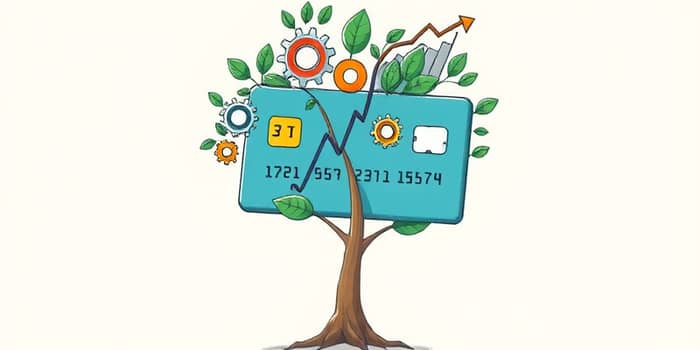
In the ever-evolving business world, credit has transcended its traditional role to become a dynamic force for unlocking hidden potential.
Credit serves as a strategic lever for companies aiming to scale rapidly without sacrificing control or equity.
This shift from viewing credit as a mere safety net to recognizing it as a growth engine marks a pivotal moment for entrepreneurs and established firms alike.
It empowers businesses to seize opportunities, innovate, and outpace competitors in crowded markets.
By leveraging forward-thinking financing, organizations can transform their aspirations into tangible, revenue-generating realities.
What Is Growth Credit?
Growth credit is a specialized form of financing designed to fuel business expansion with a focus on future potential.
It provides flexible capital through term loans with regular repayments, often structured in tranches for phased initiatives.
This approach aligns funding with specific growth strategies such as marketing campaigns, research and development, or acquisitions.
Unlike equity investments, growth credit avoids ownership dilution, making it ideal for founders who wish to retain control.
It is tailored for scale-up businesses with demonstrated growth trajectories, not early-stage startups, due to its reliance on predictable revenue streams.
Key Differentiators from Traditional Financing
To understand the unique value of growth credit, it is essential to compare it with other financing options.
This comparison highlights how growth credit bridges the gap between rigid traditional loans and dilutive equity funding.
Forward-looking assessments prioritize future revenue over historical data, enabling more adaptive financial strategies.
Target Businesses and Use Cases
Growth credit is particularly beneficial for specific types of businesses poised for expansion.
- Rapidly scaling businesses with ambitious plans that require agility to outmaneuver competitors.
- Tech-enabled firms seeking funds for product development or market expansion, leveraging intellectual property.
- Acquisitive strategies using tranching to align with merger and acquisition timelines for synergy integration.
Eligibility for growth credit typically involves several key criteria that demonstrate stability and potential.
- A demonstrable revenue growth track record with strong gross margins.
- A compelling value proposition backed by a robust financial model including downside scenarios.
- A clear growth strategy and business plan that outlines specific use cases for the funding.
These elements ensure that businesses are well-prepared to leverage credit effectively for sustainable growth.
Technological Enablers: Credit Decisioning Engines
Modern credit systems rely heavily on advanced technologies to streamline and enhance the lending process.
Credit decisioning engines are AI-driven software that automate creditworthiness assessments using multi-variable data.
Real-time approvals boost customer satisfaction by providing immediate feedback in retail or point-of-sale financing scenarios.
These engines analyze factors such as credit scores, income data, and banking behavior to predict borrower behavior accurately.
They ensure compliance with regulations like the Equal Credit Opportunity Act while integrating seamlessly with lending platforms.
The benefits of these technological tools are numerous and transformative for the lending industry.
- Faster and more consistent decision-making across various loan products, from mortgages to small business loans.
- Predictive analytics that forecast future financial behavior by identifying trends and patterns in data.
- Configurability for nuanced approvals, allowing lenders to tailor criteria based on specific risk profiles.
- Broader data sources that reduce default risk by providing a more comprehensive view of applicants.
- AI-first examples like NewgenONE that adapt and explain decisions, unifying the entire credit lifecycle.
This technological advancement makes credit more accessible and efficient, supporting growth initiatives.
Broader Market Context and Economic Impact
The rise of growth credit is part of a larger trend in the global financial landscape.
Private credit has grown to a $3 trillion global market since the 2008 financial crisis.
This expansion is driven by bank regulations, high interest rates, and the need for flexible financing in the middle-market sector.
Private credit supports innovation and job creation by providing capital to firms with revenues between $10 million and $1 billion.
These businesses form the backbone of many economies, enabling scaling and economic resilience through co-lending with traditional banks.
Financing as a growth engine goes beyond mere financial support; it instills confidence for strategic expansion.
Hybrid models combining loans and equity can sustain operations during rapid growth phases.
This approach mirrors self-reinforcing revenue mechanisms, such as paid advertising cycles, where credit acts as a lever.
By viewing credit as an integral part of the growth strategy, businesses can unlock undiscovered value and drive long-term success.
How to Secure Growth Credit
Securing growth credit requires careful preparation and a clear articulation of your business's potential.
Lenders assess not only financial metrics but also how the funds will be used to fuel growth initiatives.
Articulate a compelling business plan that outlines your growth strategy and financial projections in detail.
This plan should include realistic scenarios and demonstrate how the credit will be repaid through enhanced revenue streams.
Preparation steps are crucial to increase your chances of approval and ensure optimal use of the funds.
- Develop a robust financial model that accounts for various growth phases and potential challenges.
- Clearly define the specific use cases for the credit, such as scaling marketing efforts or investing in research.
- Gather documentation of past performance, including revenue growth and margin stability.
- Engage with lenders who have expertise in your industry, especially for tech or high-growth sectors.
- Consider tranching options to align drawdowns with milestone achievements in your growth plan.
By following these steps, businesses can position themselves as attractive candidates for growth credit.
This proactive approach not only secures funding but also fosters a culture of strategic financial management.
Growth credit, when used wisely, can be the engine that propels a business to new heights, unlocking value that was previously untapped.
It represents a shift towards more intelligent, forward-looking financing that aligns with modern business dynamics.
Embracing this tool can lead to sustained expansion, innovation, and competitive advantage in an increasingly complex market.
References
- https://growthlending.com/knowledge-bank/what-is-growth-credit-and-how-can-it-support-my-business
- https://newgensoft.com/za/blog/everything-you-need-to-know-about-credit-decisioning-engine/
- https://loanpro.io/glossary/decisioning-engine
- https://aquarianlp.com/blog/2025/04/30/the-future-of-private-credit-a-growth-engine-for-investors-and-the-economy/
- https://www.biz2credit.com/business-loan/role-of-financing-options-in-growth-sustainability
- https://hginsights.com/2024/03/08/what-is-a-growth-engine/
- https://www.solidgrowth.com/what-is/growth-engine
- https://wealthandfinance.digital/payment-processing-as-a-growth-engine-core-metrics-finance-pros-should-track/
- https://www.lendflow.com/post/unlock-opportunities-lendflow-credit-engine