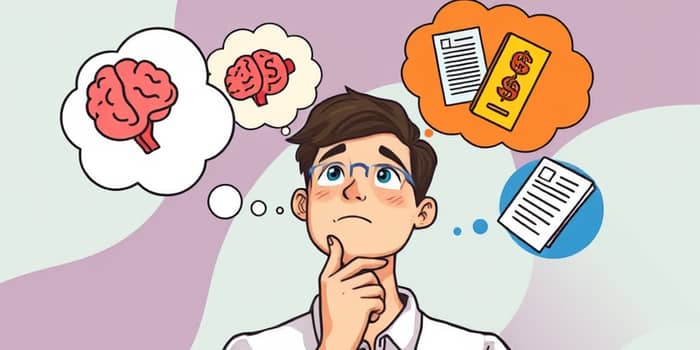
Borrowing money is a decision that goes far beyond simple math and interest rates.
It is deeply intertwined with our psychological makeup and emotional triggers, shaping how we approach debt and financial risks.
From student loans to credit cards, every borrowing choice reflects a complex interplay of personality, bias, and social influence.
This article explores the hidden drivers behind loan decisions, offering practical insights to help you navigate your financial journey with greater awareness and confidence.
By understanding these factors, you can transform borrowing from a source of stress into a tool for growth and stability.
The Hidden Drivers of Borrowing Decisions
At the heart of borrowing behavior are core psychological factors that predict how individuals handle debt.
Research shows that key personality traits significantly influence financial decision-making and repayment capacity.
For instance, traits like self-control and conscientiousness are linked to better credit risk outcomes, while neuroticism often has a negligible impact.
- Effective financial decision-making
- Self-control and conscientiousness
- Selflessness and charitable attitude
- Attitude toward money
These variables can improve access to loans and enhance repayment behavior, making them crucial for lenders and borrowers alike.
Another critical factor is psychological ownership of borrowed money, where individuals feel a sense of belonging over funds they have not earned.
This perception, especially strong with credit products, directly affects willingness to borrow and actual borrowing over time.
Studies indicate that higher psychological ownership correlates with increased interest in loan applications and sustained debt use.
Cognitive Biases and Emotional Influences
Our minds are prone to biases that can cloud judgment when it comes to borrowing.
Confirmation bias leads borrowers to seek information that justifies their decisions, ignoring warning signs.
Overconfidence causes people to underestimate risks and overestimate their ability to repay, often resulting in excessive debt.
Social proof makes individuals mimic the borrowing habits of peers without proper analysis, while fear and anxiety can paralyze decision-making, preventing necessary financial moves.
- Confirmation bias
- Overconfidence
- Social proof
- Fear and anxiety
Recognizing these biases is the first step toward making more rational and informed borrowing choices.
How Personality Shapes Loan Choices
Different personality needs influence the types of loans individuals are drawn to.
Research identifies two key dimensions: the need for material resources and the need for arousal.
People with higher arousal needs show stronger intentions for various loans, such as home improvement or business loans.
- Need for material resources: Associated with general borrowing intentions
- Need for arousal: Drives interest in specific loan types like student or personal loans
Interestingly, attitudes toward borrowing have a trivial effect on those with low scores in these areas but become pronounced for high-scoring individuals.
This highlights how personal psychology tailors borrowing behavior to individual desires and motivations.
The Purpose of Borrowing: A Psychological Perspective
The reason for borrowing—whether for pleasure or necessity—elicits strong psychological reactions from lenders.
Hedonic purchases, like vacations or luxury items, often spark significant anger and disapproval, even after full repayment.
In contrast, utilitarian purchases, such as education or home repairs, are met with more acceptance and understanding.
This dynamic affects both personal lending and larger-scale financial interactions, shaping social and economic relationships.
Practical Implications for Better Borrowing
Understanding borrowing psychology can lead to more informed decisions and healthier financial habits.
For individuals, it means assessing personal biases and aligning loans with long-term goals rather than impulsive desires.
Financial institutions can benefit by incorporating psychological assessments into credit decisions, improving risk prediction and customer outcomes.
- Conduct self-assessments of personality traits before borrowing
- Seek financial education that addresses cognitive biases
- Use loans primarily for utilitarian purposes to gain social approval
- Monitor peer influences to avoid unnecessary debt
By applying these insights, borrowers can reduce stress and build a more secure financial future.
Research Behind the Insights
The findings in this article are backed by rigorous scientific studies from recent years.
Methodologies like logistic regression and psychometric testing have validated the predictive power of psychological variables in borrowing contexts.
These approaches help uncover the subtle ways our minds influence financial behavior, from loan defaults to repayment success.
- Logistic regression analysis for credit risk prediction
- Theory of Planned Behaviour framework in student loan studies
- PLS-SEM with bootstrapping for robust pathway identification
- Psychometric testing of personality traits
- Archival studies and experiments on psychological ownership
- Neuroimaging studies during lending decisions
This multi-method research provides a solid foundation for understanding and improving borrowing practices.
Embracing the psychology of borrowing empowers you to take control of your financial destiny.
By recognizing the internal and external forces at play, you can make decisions that support your well-being and aspirations.
Let this knowledge guide you toward smarter, more conscious borrowing that aligns with your values and life goals.
Remember, every loan is not just a financial transaction but a reflection of your psychological landscape—navigate it wisely.
References
- https://pmc.ncbi.nlm.nih.gov/articles/PMC8067141/
- https://www.tandfonline.com/doi/full/10.1080/23322969.2024.2358008
- https://richie.ai/blogs/the-psychology-of-borrowing-influencing-factors-in-financial-decision-making
- https://openjournals.libs.uga.edu/fsr/article/download/3296/2924
- https://pubsonline.informs.org/doi/10.1287/mnsc.31.8.970
- https://www.ama.org/2021/10/25/does-feeling-like-you-own-borrowed-money-make-you-spend-more/
- https://www.psychologicalscience.org/news/were-only-human/the-neurology-of-lending.html
- https://www.hks.harvard.edu/centers/mrcbg/programs/growthpolicy/friendship-fallout-and-bailout-backlash-psychology-borrowing
- https://www.frontiersin.org/journals/psychology/articles/10.3389/fpsyg.2020.537606/full
- https://myscp.onlinelibrary.wiley.com/doi/abs/10.1002/jcpy.1410