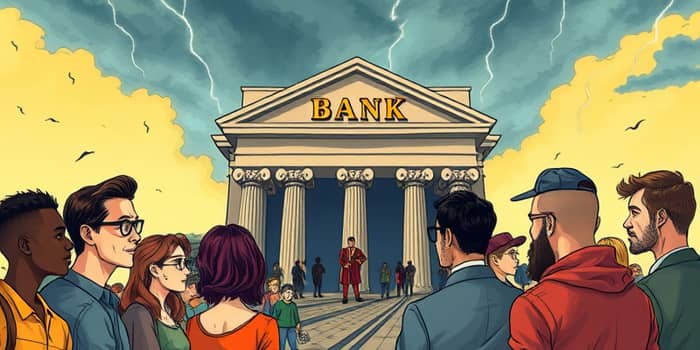
Access to credit forms the backbone of personal dreams, entrepreneurial ventures, and homeownership aspirations. Yet during economic downturns, this crucial lifeline often becomes harder to secure. As banks tighten their lending standards, families and businesses alike encounter barriers that can amplify hardship. Understanding these dynamics is essential to navigate challenges and advocate for solutions.
Historical Patterns of Lending During Recessions
When recession strikes, lending volumes often decline or stall. Analysis of past downturns reveals that banks, reacting to losses and uncertainty, apply stricter underwriting rules, even as borrowers yearn for relief. In many cases, significantly reduced credit supply conditions combine with weak demand, resulting in a double blow to economic activity.
- Tightened underwriting standards by banks
- Borrowers postponing investment and consumption
- Heightened risk aversion across financial institutions
During the Great Recession (2007 2009), small business lending collapsed most severely in rural and low-income counties, showing that geographic and demographic factors matter. Similarly, mortgage availability plummeted, driving many potential homeowners from the market and stalling residential construction.
Key Mechanisms Behind Credit Tightening
Banks tighten credit in response to multiple stressors. First, rapidly rising policy interest rates raise funding costs. Second, direct losses from loan defaults and bank failures stoke caution. Third, global supply chain disruptions and market volatility drive banks to hoard capital. Research attributes up to half of recent tightening to major bank failure supply shocks, illustrating how failures in one corner of the sector reverberate broadly.
These dynamics produce ripple effects: lending officers become more conservative, requiring higher credit scores, larger down payments, or additional collateral. Even creditworthy borrowers find themselves squeezed.
Sector-Specific Impacts
The fallout of credit tightening is not uniform. Different segments of the economy feel the pinch in distinct ways.
- Small Businesses: Reduced lines of credit limit payroll and expansion, leading to layoffs and shutdowns.
- Residential Mortgages: Availability indices fell by over 30% in early 2020, drying up purchase and refinance activity.
- Consumer Loans: Traditional credit cards and personal loans give way to payday services and buy-now-pay-later schemes, reflecting increased reliance on alternatives.
- Student Loan Borrowers: Higher unemployment translates into rising balances and elevated default rates, compounding long-term financial strain.
Recent Trends and Ongoing Effects
Post-2022 data show that banks continued to hold back on new credit into 2024 and 2025. Delinquency rates climbed: mortgage delinquencies reached nearly 4% in Q4 2024, while consumer loan defaults hovered around 2.7%. Household debt ticked upward to $18.6 illion in Q3 2024, driven by large mortgage and auto loan balances.
Despite no official recession in some regions, credit supply remains tight. Economists project persistent unemployment gaps through 2026 and forecast only minor relief in consumer borrowing costs. For small firms, lingering delinquencies signal ongoing distress, with originations below pre-pandemic levels.
Long-Term Consequences and Future Outlook
Prolonged credit constraints stifle recovery by delaying business investment, dampening consumer spending, and discouraging home purchases. The cumulative impact can slow GDP growth by up to 0.5 percentage points annually. While inflation may dip slightly, the cost comes in lost jobs and stalled innovation.
Policymakers and lenders can mitigate these outcomes through targeted interventions. Measures include community development banks supporting rural entrepreneurs, federal guarantees for student and small business loans, and adaptive monetary policies that balance inflation control with credit access.
Charting a Path Forward
In the face of tightening credit, individuals and businesses are not powerless. Proactive steps can ease the burden and foster resilience:
- Strengthen financial profiles by reducing high-interest debt.
- Seek alternative lenders such as credit unions or community finance institutions.
- Advocate for policy reforms that expand loan guarantees and streamline underwriting for low-risk borrowers.
By understanding the forces at play and empowering stakeholders, we can ensure that credit remains a tool for growth rather than a barrier. Collaborative efforts between regulators, financial institutions, and communities are vital to restoring confidence and renewing opportunity for all.
References
- https://www.frbsf.org/research-and-insights/publications/economic-letter/2024/05/economic-effects-of-tighter-lending-by-banks/
- https://aae.wisc.edu/2024/06/27/lending-practices-of-banks-and-credit-unions-before-and-during-the-great-recession/
- https://argyle.com/blog/loan-fraud-delinquincy-recession/
- https://www.federalreserve.gov/publications/November-2024-Borrowing-by-Businesses-and-Households.htm
- https://www.newyorkfed.org/microeconomics/hhdc
- https://www.richmondfed.org/publications/research/economic_brief/2025/eb_25-41
- https://www.statista.com/topics/9883/bank-lending-during-recessions/
- https://www.federalreserve.gov/publications/2019-may-financial-stability-report-borrowing.htm
- https://www.richmondfed.org/publications/research/economic_brief/2025/eb_25-03