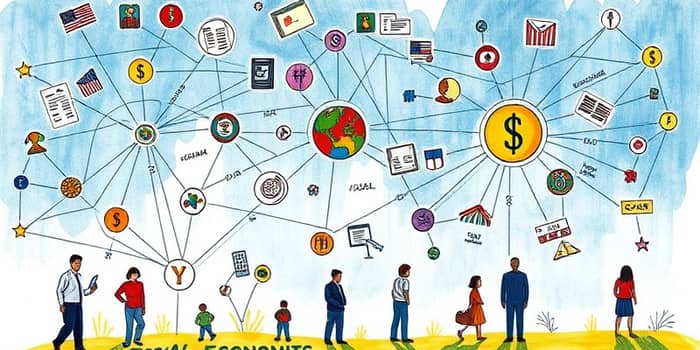
Every decision you make, from a small purchase to a major investment, leaves a mark on the world's financial landscape.
This mark is known as your fiscal footprint, a concept that reveals how policies, businesses, and personal actions ripple through economies.
By grasping this idea, you can navigate uncertainty and contribute to a more resilient global system, transforming abstract theories into practical tools for empowerment.
It’s not just about numbers; it’s about understanding the interconnected web of cause and effect that defines our shared economic reality.
This article will guide you through the layers of fiscal footprint, offering insights that inspire and actionable steps to help you thrive.
What Is the Fiscal Footprint?
At its core, the fiscal footprint measures the impact of actions on a government's fiscal burden, including debt, taxes, and spending.
For policies, it evaluates whether they tighten or loosen constraints, with a negative direct footprint often arising from measures that ease debt rollover.
Beyond policy, it extends to organizational and personal levels, assessing how economic activities influence sustainability and well-being.
Think of it as a lens through which we view the economic consequences of our choices, big and small.
This understanding is crucial for making informed decisions in a complex world.
The Policy Connection: How Governments Shape Our Economy
Macroprudential and monetary policies play a pivotal role in defining fiscal footprints.
They operate through direct channels, such as increasing bond demand and lowering rollover costs.
- Direct effects: Policies raise bond prices, reducing government debt burdens through mechanisms like the equation for fiscal burden.
- Inflation impacts: Unexpected inflation can erode real debt value and boost revenues, creating a negative footprint.
- Unconventional tools: Quantitative easing adds extra negative effects via central bank income, but risks from defaults.
- Indirect channels: These alter real activity, affecting tax bases and potential bailouts, with outcomes that can be positive or negative.
Comparisons show that macroprudential footprints are similar to monetary ones but lack extras like seignorage.
This interplay highlights the delicate balance policymakers must strike to avoid fiscal crises.
| Footprint Type | Key Characteristics | Examples |
|---|---|---|
| Policy-Level | Affects government budget, debt costs, and economic activity | Tighter regulation lowering rollover costs |
| Economic | Measures sustainability via direct, indirect, and induced effects | Organizational contributions to GDP |
| Personal | Individual financial actions impacting credit and economy | Spending patterns influencing tax revenues |
| Global | Spillover effects across borders on innovation and risk | US fiscal policy affecting worldwide growth |
Beyond Policy: The Broader Economic Footprint
At organizational and national levels, fiscal footprints encompass more than just government finances.
They measure total economic sustainability through direct, indirect, and induced effects.
- Direct impacts: Include salaries, taxes, and gross value added (GVA), which approximates GDP contribution.
- Indirect effects: Arise from supply chain purchases and upstream economic activities.
- Induced influences: Stem from household spending triggered by initial economic actions.
Key indicators like income, employment, and labor productivity provide a snapshot of economic health.
Integrating the triple bottom line, this footprint links to environmental and social dimensions, emphasizing holistic decision-making.
Applications range from assessing Sustainable Development Goals to informing research and development policies.
By understanding this, businesses can enhance transparency and stakeholders can make better choices.
Your Role in the Economy: The Personal Financial Footprint
Your daily financial actions contribute to the aggregate fiscal burden in ways you might not realize.
From taxes to debt, personal footprints affect credit scores, financial history, and even health outcomes.
- Credit management: Responsible borrowing and spending can improve your economic standing.
- Tax contributions: Payments directly support public services and government budgets.
- Debt dynamics: Personal debt levels influence broader economic stability and fiscal pressures.
This connection empowers you to see your role in the larger economic picture.
By managing your finances wisely, you can reduce negative impacts and foster positive change.
Practical steps include budgeting, saving, and advocating for policies that align with sustainable growth.
Global Implications: How Our Footprints Connect Worldwide
Fiscal footprints don't stop at borders; they create ripple effects across the globe.
US fiscal policy, for instance, influences innovation, growth, and risk premia in other countries.
Sectoral examples, like renewable energy, demonstrate how projects boost local tax revenues and economic activity.
Variants such as the financial footprint quantify impacts on environmental and social systems.
- Global trade: Policies in one nation can affect supply chains and economic stability worldwide.
- Risk sharing: Financial crises often have cross-border consequences, highlighting interconnectedness.
- Sustainability goals: International cooperation is key to managing shared fiscal challenges.
Understanding this helps navigate an increasingly globalized economy with empathy and foresight.
It encourages collaborative efforts to build a more equitable and resilient world.
Taking Action: Managing Your Fiscal Footprint for a Better Future
Now that you understand the layers, it's time to apply this knowledge practically.
Start by assessing your own financial habits and their broader impacts.
- Educate yourself: Stay informed about economic policies and how they affect you.
- Adopt sustainable practices: Support businesses and investments that promote positive footprints.
- Engage in advocacy: Voice support for responsible policies that balance growth with fiscal health.
- Monitor personal finance: Use tools to track spending, debt, and savings for better decision-making.
- Collaborate globally: Participate in discussions on international economic issues to foster unity.
Remember, small changes can lead to significant collective impacts.
By embracing your role, you contribute to a more stable and prosperous economy for all.
This journey is not just about numbers; it's about building a legacy of mindful economic stewardship.
Let this understanding inspire you to act with intention and hope for a brighter tomorrow.
References
- https://www.bcentral.cl/documents/33528/133226/macroprufiscal-v1.pdf/38b97dd0-d974-0ace-e3bf-d3d070246277?t=1573286395890
- https://www.wifor.com/en/economic-footprint/
- https://lifestyle.sustainability-directory.com/area/financial-footprint/
- https://www.spea.at/topics/economic-footprint-impact-analyses/?lang=en
- https://fincent.com/glossary/financial-footprint
- https://blog.implan.com/understanding-implan-effects