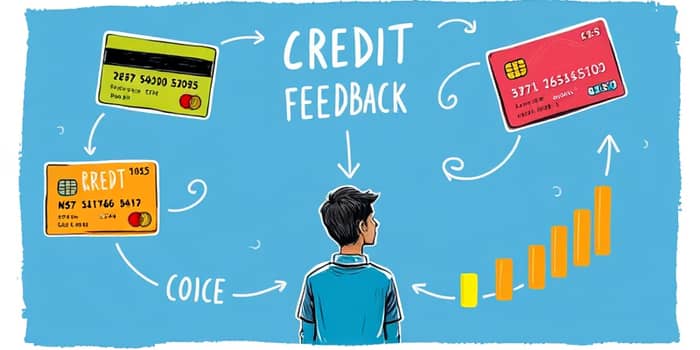
Your spending decisions create a powerful cycle that can either boost or break your credit. By understanding how each purchase influences your credit utilization and overall score, you can take control of this loop rather than letting it control you.
Understanding the Feedback Loop in Credit
At its core, the feedback loop in credit emerges when high spending raises utilization ratio and triggers a series of consequences that can affect lending terms, interest rates, and future access to credit. When balances climb relative to limits, credit scoring models interpret this as a sign of risk, often resulting in a lower score.
Once your score dips, lenders may charge higher interest rates or deny applications, which in turn can strain your budget and tempt you to rely more heavily on existing credit lines. This cascade of events reinforces itself, creating either a downward spiral or a positive ascent depending on how you manage balances and payments.
Key Components Affected by Spending
Your credit score is calculated from multiple weighted factors, each one sensitive to how much you spend and how promptly you repay. Understanding these elements is essential for steering the feedback loop in your favor.
Among these, the amounts owed factor dominates utilization and acts as the primary lever for the feedback loop. When you use more than 30% of your credit limit—especially on individual cards—you risk signaling financial stress to scoring models.
The Mechanics of Impact
The feedback loop unfolds through several mechanisms that interact in complex ways. Recognizing these can empower you to break negative cycles.
- Spending → Utilization Spike → Score Drop: Carrying balances above recommended thresholds results in immediate score declines as credit models flag high-risk usage.
- Lower Score → Worse Terms/Access: Reduced creditworthiness leads to higher interest rates or application rejections, increasing your cost of borrowing.
- Reinforcement through Feature and Outcome Loops: On-time payments and controlled spending build positive momentum, while defaults amplify negative outcomes.
These interactions perpetuate themselves: a default not only lowers your score but also triggers higher interest, which can make fulfilling future payments more challenging, further entrenching a negative cycle.
Benchmarks and Practical Tips
Keeping your utilization within optimal ranges is one of the simplest yet most effective ways to harness the feedback loop positively.
- 0–1% Utilization: Generates top-tier scores but may lack activity data if at 0%.
- 1–10% Utilization: Ideal for achieving exceptional scores above 800.
- Under 30% Utilization: Maintains a healthy profile and borrowing power.
- Above 30% Utilization: Triggers noticeable score declines and risk premiums.
- Near 100% Utilization: Signals critical risk and may lead to denial of new credit.
To keep utilization low and your score rising, consider these tactics:
- Pay Down Before Statement Closing: Reduces reported balances to credit bureaus each month.
- Request Credit Limit Increases Responsibly: Expands your available credit, lowering utilization ratio.
- Set Up Automatic Payments: Ensures on-time repayment and prevents delinquencies.
- Monitor Trends on Recent Balances: Helps you spot rising usage before scores are affected.
Turning the Loop Into an Advantage
While the feedback loop can spiral downward, it can also become a catalyst for growth when managed proactively. Every instance of paying down a balance or successfully negotiating a better rate creates positive reinforcement.
As your score improves, you may qualify for lower interest products and higher limits, making it easier to maintain low utilization. This positive cycle of credit improvement can accelerate your path to financial goals, whether that means funding a home purchase, securing low-cost auto financing, or unlocking a premium rewards card.
Broader Implications and Cautions
In the digital age, artificial intelligence and machine learning models are increasingly responsible for credit decisions. While these systems can offer rapid assessments, they can also amplify existing biases.
Communities or individuals with limited credit history or historical underbanking may find themselves caught in adversarial feedback loops that reinforce exclusion. Understanding the broader context of these models—such as how sampling methods or threshold adjustments create multiple equilibria—can help you advocate for fairer lending practices and seek alternative data solutions for a more accurate reflection of creditworthiness.
Putting Knowledge Into Action
By mastering the dynamics of the feedback loop, you can transform spending habits from a liability into a strategic tool. Regularly review your credit reports, track utilization trends, and plan purchases around payment cycles.
Empower yourself with clear goals, whether that’s achieving a score above 750 within six months or reducing overall debt by 20% this year. With consistent effort, you’ll not only escape negative spirals but also build lasting financial resilience.
Every payment you make and every balance you lower contributes to a stronger credit profile and greater financial freedom. Take control of the loop today—your future creditworthiness depends on the actions you start now.
References
- https://dl.acm.org/doi/fullHtml/10.1145/3617694.3623227
- https://www.bankrate.com/credit-cards/advice/credit-utilization-ratio/
- https://www.firstmutualholding.com/resources/why-your-credit-utilization-ratio-matters/
- https://www.experian.com/blogs/ask-experian/credit-education/score-basics/credit-utilization-rate/
- https://www.equifax.com/personal/education/debt-management/articles/-/learn/credit-utilization-ratio/
- https://www.creditkarma.com/credit/i/credit-card-utilization-and-your-credit-score
- https://www.accessiblelaw.untdallas.edu/post/when-algorithms-judge-your-credit-understanding-ai-bias-in-lending-decisions
- https://www.communityfirstfl.org/resources/blog/how-much-does-credit-card-usage-affect-my-credit-score-e853e0b627cf8f1421d2189f16c51e9d
- https://www.fico.com/blogs/how-use-alternative-data-credit-risk-analytics
- https://finred.usalearning.gov/Money/InOutCredit
- https://www.fhfa.gov/policy/credit-scores