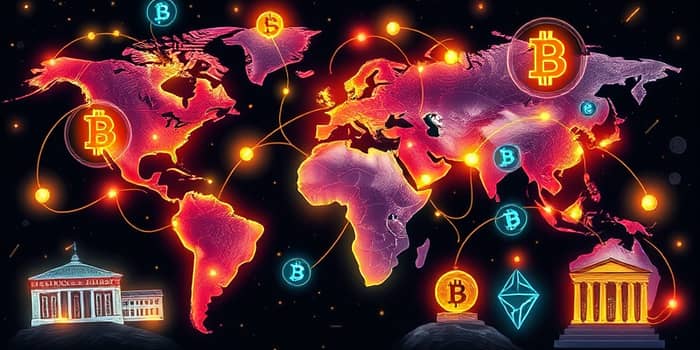
Global finance underpins the modern world, weaving together nations, institutions, and technologies in an ever-evolving network. To navigate this landscape, we must decode its architecture, actors, challenges, and trajectory.
The Architecture of Global Finance
At its core, global finance is a tapestry of cross-border capital flows, payment and settlement systems, financial markets, and institutions that connect savers, borrowers, firms, and governments across borders.
This system rests on three pillars:
- Monetary system: reserve currencies and FX markets guided by central banks;
- Financial intermediation: banks and nonbank financial institutions channeling funds;
- Market infrastructure: global networks like SWIFT, clearing houses, and payment systems.
The Evolution: From Bretton Woods to Digital Revolution
The Bretton Woods Conference of 1944 laid the foundation for a dollar-anchored system, creating the IMF and World Bank. Its collapse in the 1970s ushered in floating exchange rates and the rise of Eurodollar markets.
The 1980s and 1990s saw deregulation, capital account liberalization, and unprecedented growth of cross-border flows. The 2008 crisis exposed vulnerabilities—credit booms, leverage, complex derivatives—prompting Basel III rules and igniting the fintech wave.
Today, digital innovations like blockchain, tokenization, CBDCs, and AI are reshaping payments and settlement, while decentralized finance experiments challenge traditional models.
Key Actors and Institutions
Global finance is steered by a constellation of players:
- Central banks (e.g., Federal Reserve, European Central Bank, People’s Bank of China);
- International financial institutions (IMF, World Bank, regional development banks);
- Commercial banks and nonbank financial intermediation: insurers, pension funds, money market funds, hedge funds;
- Market infrastructures (SWIFT, CHIPS, Fedwire, securities depositories).
These actors maintain liquidity, set policy, and manage risks that ripple through economies.
Anchoring the Narrative with Data
Concrete metrics illuminate the scale and stakes of global finance:
Between 2019 and 2024, assets intermediated by banks and nonbanks surged by $122 trillion (+40%). Banks’ revenues after risk cost hit $5.5 trillion in 2024, with net income at a record $1.2 trillion.
Major Fault Lines: Geopolitics and Fragmentation
In 2025, global finance stands at a crossroads. The US-led financial order remains central, yet is challenged by a rebalancing of economic power and emerging blocs.
- US–China rivalry and the Russia–Ukraine conflict intensify financial sanctions and “weaponization of finance.”
- BRICS+ nations explore local currency settlements and alternative payment systems like CIPS and SPFS, reducing fragmentation of the global system.
- Unaligned economies could lose up to 11% of GDP if forced into rival blocs.
WF E Davos estimates extreme financial fragmentation could shave 5% off global GDP, while flows plunged over 50% in 2022 as risk aversion spiked.
Technology and the Future of Money
Digital currencies and blockchain promise new efficiencies but raise questions about stability and sovereignty. Central bank digital currencies (CBDCs) are under active development:
- Over 100 central banks exploring CBDCs, aiming to enhance payment speed and financial inclusion.
- DeFi protocols experiment with programmable contracts and tokenized assets, challenging intermediaries.
AI-driven analytics and algorithmic trading algorithms optimize risk management but also concentrate systemic vulnerabilities.
Inclusion, Inequality, and Systemic Risk
Despite growing wealth—global household and institutional wealth exceeds 350% of GDP—inequality persists.
Financial inclusion remains uneven. While fintech lowers barriers in emerging markets, 1.4 billion adults remain unbanked. The global financial safety net is roughly 20% of world GDP, yet access is skewed toward advanced economies, leaving many EMDEs exposed to shocks.
Building a Resilient Future
To chart a sustainable path, stakeholders must:
- Enhance coordination among central banks and IFIs to expand the financial safety net.
- Promote interoperable digital infrastructures to bridge traditional and decentralized systems.
- Strengthen global regulatory frameworks to manage systemic risk in banks and NBFIs alike.
By fostering innovation with prudence, encouraging diversification, and ensuring equitable access, the global financial system can evolve into a more resilient and inclusive network.
The economic blueprint of tomorrow demands both vision and vigilance. Understanding its pillars, players, data, and dilemmas is the first step toward shaping a future where finance serves people and economies, rather than dominating them.
References
- https://www.weforum.org/stories/2025/01/global-finance-crossroads-reflections-davos/
- https://www.mckinsey.com/industries/financial-services/our-insights/global-banking-annual-review
- https://www.brookings.edu/articles/is-the-global-financial-system-fracturing-under-geopolitical-pressure/
- https://www.imf.org/en/publications/gfsr/issues/2025/10/14/global-financial-stability-report-october-2025
- https://www.worldbank.org/en/publication/globalfindex
- https://www.bis.org/publ/arpdf/ar2025e.htm