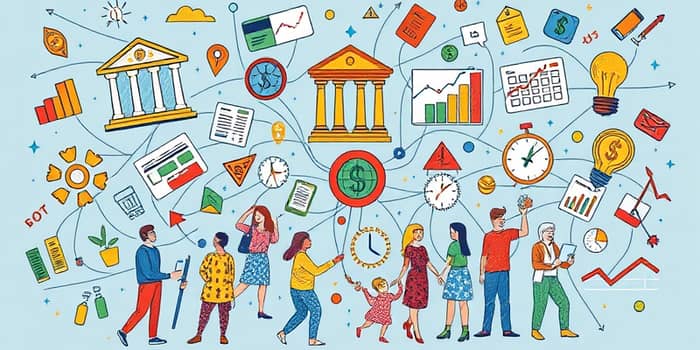
Every day, billions of transactions, loans, and approvals weave together into a vast network that shapes our personal and collective wealth. This is the credit ecosystem—a dynamic, interdependent system driving innovation, inclusion, and economic growth.
By understanding how each component interacts, individuals and businesses can navigate risks, maximize opportunities, and embrace a future empowered by financial technology. The following exploration uncovers the inner workings, empowering you with practical strategies for success.
Understanding the Foundations of Credit
The credit ecosystem is not a single institution but a tapestry of actors, technologies, and regulations collaborating to extend credit and process transactions.
At its core are:
- Issuing and Acquiring Banks that underwrite credit cards, process settlements, and manage capital flows.
- Global Payment Networks like Visa and Mastercard, setting rules and connecting merchants to issuers.
- Payment Service Providers (PSPs) and gateways securing real-time authorizations and fraud prevention.
- Credit Bureaus and scoring models evaluating borrower risk to facilitate automated decisions.
- Regulators and public registries ensuring stability, consumer protection, and data transparency.
These elements form a web of financial opportunity, balancing risk and reward while promoting liquidity and inclusion.
The Power of Credit Scores
Credit scores translate complex histories into simple numbers. Lenders rely on them to extend credit, set interest rates, and manage portfolios. Understanding their mechanics unlocks significant advantages.
Two dominant models—FICO and VantageScore—drive over 90% of lending decisions:
Building and maintaining strong scores involves more than timely payments. Consider these principles:
- Keep utilization below 30% of your limit to demonstrate responsible credit management.
- Maintain diverse account types—loans, mortgages, credit cards—to boost your credit mix.
- Avoid multiple hard inquiries in short periods to preserve your score stability.
From Transaction to Transformation
Each swipe of a card or digital wallet initiation sets off a chain reaction. Understanding this journey demystifies fees, timelines, and approvals.
The lifecycle of a credit transaction:
- Authorization: Cardholder initiates payment; processor routes request through acquirer and network to the issuing bank.
- Authentication and Approval: Issuer examines credit limits and risk models, then responds.
- Clearing and Settlement: Merchant batches transactions; funds flow from issuer to acquirer, minus fees.
- Billing and Reporting: Issuing bank bills the consumer; payment data feeds bureaus, updating credit profiles.
This authorization to settlement journey relies on split-second data exchange, fraud detection algorithms, and regulatory compliance.
Strategies for Empowering Your Financial Journey
While institutions and models underpin the ecosystem, individuals hold the power to shape their financial destiny. These actionable steps can transform your credit profile:
- Automate payments to eliminate late fees and strengthen your payment history reliability.
- Use credit-building tools like secured cards or credit-builder loans if you’re new or rebuilding.
- Monitor your credit report regularly to spot errors and dispute inaccuracies promptly.
- Leverage alternative data—rental payments, utility bills—to boost your profile through emerging platforms.
- Diversify credit types gradually, balancing installment and revolving accounts for a robust score.
Adopting these habits fosters trust with lenders and unlocks better loan terms, higher limits, and more innovative financial products.
Emerging Trends and the Future of Credit
Innovation continues to reshape the credit ecosystem. From alternative data integration to AI-driven scoring, opportunities abound for proactive consumers.
Key trends to watch:
- AI and machine learning powering behavioral scoring, capturing subtle patterns beyond traditional metrics.
- Real-time lending and instant payment experiences enabling on-the-spot underwriting for gig workers and microloans.
- Regulatory shifts advocating for open banking, expanded public credit registries, and fair access mandates.
- Digital identity solutions and blockchain promising secure, transparent data sharing across borders.
As these developments unfold, staying informed, adaptable, and disciplined will be your greatest assets in navigating tomorrow’s financial landscape.
Conclusion: Embrace the Web of Opportunity
The credit ecosystem is more than transactions; it’s a catalyst for dreams—from a first home purchase to scaling a small business. By demystifying its structures and adopting best practices, you empower yourself to seize unprecedented possibilities.
Remember, every on-time payment, strategic credit mix, and informed decision strengthens not just your score but your future. Step confidently forward and let the credit ecosystem work for you.
References
- https://prioritycommerce.com/resource-center/payment-ecosystem/
- https://www.debt.org/credit/report/scoring-models/
- https://boxopay.com/blog/merchant-payment-ecosystem-components/
- https://payally.co.uk/glossary/financial-ecosystem/
- https://www.myfico.com/credit-education/whats-in-your-credit-score
- https://www.marqeta.com/uk/demystifying-cards-guide/card-payments-ecosystem
- https://www.americanexpress.com/en-us/credit-cards/credit-intel/types-of-credit-scores/
- https://stripe.com/resources/more/the-payment-industry-ecosystem-explained
- https://www.intuit.com/blog/innovative-thinking/what-is-credit-score/
- https://www.afbank.com/article/understanding-credit-scoring-what-determines-your-credit-score
- https://www.environment.fhwa.dot.gov/env_initiatives/eco-logical/Implementing_Ecosystem_Crediting.aspx
- https://consumer.ftc.gov/credit-scores
- https://www.decta.com/company/media/what-does-the-ecosystem-mean-in-payments-understanding-key-players-and-trends