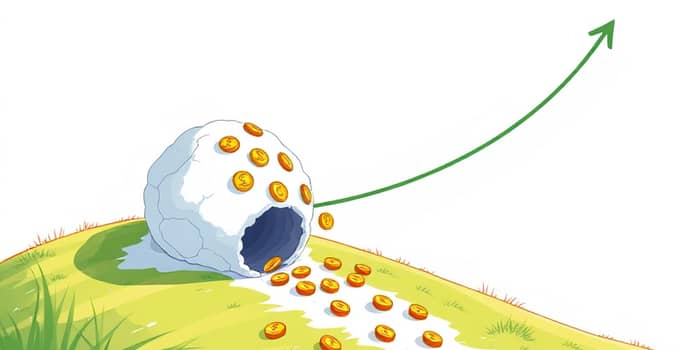
Compounding transforms modest savings into significant fortunes over time, driven by reinvested earnings.
What Is Compounding?
At its core, compounding means earning returns not only on your original investment but also on all past returns. This principal plus accumulated interest becomes a new base that generates even more gains in the next period.
In contrast, simple interest calculates earnings solely on the original principal, resulting in a linear growth path. Compounding accelerates that path into an exponential growth over time, akin to a snowball that gains mass as it rolls downhill.
Why Mathematics Matters
The fundamental formula for compound interest on a single lump sum is:
A = P (1 + r/n)^(n t), where:
- A is the future amount
- P is the initial principal
- r is the annual rate (decimal)
- n is the number of compounding periods per year
- t is the number of years invested
For continuous compounding, the equation becomes A = P e^(r t), resulting in slightly higher outcomes compared to periodic compounding.
Even a modest annual rate produces dramatic differences over decades. Consider $5,000 at 5% simple interest versus 5% compounded annually over 10 years:
Here, compounding yields an additional $644 in earnings, illustrating how reinvested returns amplify results.
The Power of Time
Time is the most potent variable in the compounding equation. Early contributions have more periods to accumulate gains and produce a snowball effect rolling downhill.
Case Study A:
- Investor A starts at age 25, invests £6,000/year for 15 years, then stops. At age 65, the balance grows to ~£468,000.
- Investor B starts at age 40, invests £6,000/year for 25 years. By age 65, this strategy yields ~£299,000.
Despite investing less total capital, Investor A ends up with considerably more wealth due to early compounding cycles.
Case Study B:
- An investor who saves $500/month at 6% for 40 years can accumulate nearly $1,000,000 by retirement.
These examples underscore how time in the market beats timing and why beginning early is crucial.
Practical Strategies to Harness Compounding
To maximize compounding benefits, focus on consistency, reinvestment, and discipline. Key strategies include:
- Start as soon as possible to maximize early compounding cycles accumulate.
- Automate contributions to maintain regular investment habits without emotion.
- Reinvest dividends and interest to ensure every penny continues growing.
- Diversify across asset classes to balance risk and reward effectively.
By combining these approaches, you can turn disciplined savings into a powerful engine for wealth creation.
Where Compounding Happens in Personal Finance
Compounding occurs in a variety of accounts and instruments, each with different risk and return profiles:
- Savings accounts and CDs: Offer daily or monthly compounding at lower rates.
- Bonds and fixed-income instruments: When coupons are reinvested, the effect compounds.
- Equities and funds: Reinvested dividends and capital gains drive long-term growth.
- Retirement accounts: Tax-deferred compounding can dramatically boost after-tax outcomes.
Understanding where and how returns are reinvested helps select the right vehicles for your goals.
Conclusion: Embracing the Snowball
Compounding is not just a financial formula—it’s a mindset that rewards patience and persistence. By starting early and maintaining disciplined contributions, you tap into an accelerating exponential pace that transforms modest inputs into life-changing wealth.
Remember, every journey begins with a single deposit. Embrace the snowball effect, stay invested, and let time work relentlessly in your favor.
References
- https://easymoney.com/blog/the-magic-of-compounding-how-to-build-long-term-wealth
- https://www.fiducientadvisors.com/blog/the-power-of-compounding-how-time-can-be-your-best-investment-ally
- https://www.home.saxo/learn/guides/trading-strategies/how-to-maximise-your-compounding-returns-a-comprehensive-guide
- https://www.westernsouthern.com/lafayette/learn/financial-education/how-does-compound-interest-work
- https://www.americancentury.com/insights/compound-interest/
- https://www.financialplanningassociation.org/article/journal/MAY14-why-investors-need-understand-shape-compound-growth-curve
- https://www.wellsfargo.com/financial-education/investing/compound-interest-growth/