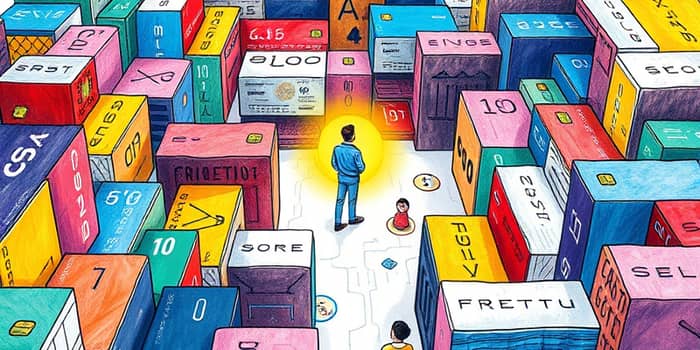
In 2025, credit markets resemble a maze, full of twists shaped by policy, technology, and consumer behavior. Understanding the corridors of this labyrinth is essential to avoid pitfalls and seize opportunities.
Why Credit Feels Like a Labyrinth in 2025
The American Bankers Association’s Credit Conditions Index reached 34.4 in Q3 2025, signaling that lenders expect worsening credit conditions over six months. Tightening arises from a softening labor market, inflation above the Fed’s 2% target, and slower growth impacting smaller businesses and lower-income consumers.
Though the Federal Reserve has initiated rate cuts, these adjustments offer only partial relief. Benchmark yields have declined after cuts, yet higher-for-longer rate expectations persist, creating a complex balance between costly borrowing dynamics and improved debt servicing for resilient borrowers.
Consumer credit continues to expand but remains unevenly affordable. In October 2025, federal data show a 2.2% annual rise in total consumer credit, with credit cards growing 4.9% and non-revolving credit up 1.3%. At the same time, pockets of high-cost debt place heavy burdens on vulnerable households.
Financial institutions appear resilient. Credit unions reported $2.40 trillion in assets and $1.70 trillion in loans in Q3 2025, with net worth ratios improving. Yet global banks anticipate credit losses to rise by roughly 7% in 2025, facing evolving risks including geopolitical tensions and commercial real estate stress.
Understanding the Foundations of Credit
At its simplest, credit is the ability to borrow money or access goods now and pay later. This system underpins mortgages, auto purchases, student financing, and everyday retail decisions.
Credit takes several forms, each with distinct features and requirements:
- Revolving credit allows ongoing borrowing up to a limit, such as credit cards and lines of credit.
- Installment loans include auto loans, personal loans, and mortgages with fixed payment schedules.
- Specialized financing options like medical payment plans, buy-now-pay-later, and retail store cards.
- Business credit structures such as merchant cash advances, equipment financing, and trade credit.
These credit types intertwine with personal behavior, economic trends, and institutional rules, creating a maze where each turn carries potential gains or risks.
Decoding Credit Scores: Your Map Through the Maze
Credit scores serve as your map within the labyrinth, condensing complex data into a three-digit summary of risk. Scores typically range from 300 to 850, with higher values unlocking better terms and access.
General score categories:
- 300–579: Poor
- 580–669: Fair
- 670–739: Good
- 740–799: Very Good
- 800–850: Exceptional
Understanding the factors behind your score can guide your strategy for improvement. A FICO-style breakdown distributes influence as follows:
While FICO remains ubiquitous, VantageScore and niche scoring models incorporate rental payments, utility bills, and even telecom history. These alternative inputs can help individuals with limited traditional credit profiles. alternative scoring can boost thin-file profiles, but may differ from lender preferences.
Avoiding Pitfalls and Building Strength
Navigating the credit labyrinth requires caution. Common missteps can leave you lost in high costs and restricted options:
- Late or missed payments, even once, can drop your score significantly.
- High utilization—balances above 30% of your limit—signals elevated risk.
- Collections, charge-offs, bankruptcies, and foreclosures impose derogatory marks for years.
- Frequent hard inquiries from multiple new applications in a short span.
- Closing old accounts can shorten your credit history and raise utilization ratios.
Conversely, disciplined habits act as a compass, guiding you toward stronger credit standing:
- Always pay at least the minimum on time, every single month.
- Keep balances low—ideally under 30% utilization per account.
- Maintain and occasionally use long-standing accounts to preserve account age.
- Build a healthy mix of installment and revolving accounts over time.
- Limit hard inquiries by spacing out new credit requests.
- Use tools like automatic payments and alerts to avoid oversights.
Leveraging Credit for Your Purchasing Power
Effective credit management translates directly into lower borrowing costs and enhanced buying capacity. Consumers with scores above 740 often secure the lowest rates on mortgages, auto loans, and personal loans. Those rates produce:
- Lower monthly payments for the same loan amount.
- The ability to borrow more at the same payment level, boosting purchase power.
Lenders determine rates using credit tiers aligned with score brackets. For example, each 20-point score increase in the high 700s may drop annual interest by 0.1–0.25%. Over a 30-year mortgage, these small differences can save thousands, underscoring the value of continuous improvement.
By contrast, individuals with scores below 580 may still gain credit access but face significantly higher rates, fees, and security deposits. The difference can amount to tens of thousands of dollars in interest over the life of a mortgage or auto loan.
Inflation further complicates the picture. As prices rise, the real value of income and savings declines. Borrowers relying on credit face higher costs when rates climb to combat inflation. In 2025, despite easing rates from prior peaks, elevated consumer prices continue to squeeze household budgets and demand keen credit navigation.
Navigating the Future: Adapting to an Evolving Labyrinth
The credit landscape is never static. Emerging trends include growing use of algorithmic credit scoring and broader adoption of alternative data sources for underwriting. Consumers often face information asymmetry, unaware of the unseen factors shaping their credit access.
Digital wallets and fintech platforms now offer instant prequalification with soft pulls, allowing consumers to compare offers without harming scores. This transparency empowers more informed choices, though it also increases complexity. instant prequalification via soft inquiries helps avoid unnecessary hard pulls.
To traverse this evolving maze:
- Stay informed about policy shifts, market trends, and new scoring models.
- Review your credit reports regularly to spot errors and address issues swiftly.
- Leverage budgeting tools and alerts to maintain consistent on-time payments.
- Consult financial professionals if you encounter complex business or specialized credit scenarios.
Remember that credit is a tool. Approach it with respect, armed with information and proactive habits, and you will find the center of the maze rather than wander its corridors. Embrace proactive credit management techniques, adapt to market shifts, and treat each decision as a deliberate step toward financial empowerment.
References
- https://www.aba.com/about-us/press-room/press-releases/cci-q3-2025
- https://www.sccu.com/articles/personal-finance/how-credit-score-can-impact-purchasing-power
- https://ncua.gov/newsroom/press-release/2025/ncua-releases-third-quarter-2025-credit-union-system-performance-data
- https://drbank.com/whats-new/your-credit-score-and-its-impact-on-your-personal-financial-goals/
- https://www.ssga.com/us/en/institutional/insights/q4-2025-credit-research-outlook
- https://www.finra.org/investors/personal-finance/how-your-credit-score-impacts-your-financial-future
- https://www.chase.com/personal/credit-cards/education/build-credit/financial-decisions-that-lead-to-poor-credit
- https://www.cambridgeassociates.com/insight/2025-outlook-credit-markets/
- https://pmc.ncbi.nlm.nih.gov/articles/PMC6187788/
- https://www.federalreserve.gov/releases/g19/current/
- https://nul.org/blog/your-credit-why-credit-reports-and-scores-matter-your-financial-health
- https://www.spglobal.com/ratings/en/regulatory/article/241204-credit-faq-global-banking-outlook-2025-the-case-for-cautious-confidence-s13335691
- https://www.experian.com/blogs/ask-experian/credit-education/score-basics/what-affects-your-credit-scores/
- https://financialaid.berkeley.edu/center-for-financial-wellness/financial-literacy-hub/understanding-credit/
- https://hesfintech.com/blog/2025-alternative-credit-scoring-landscape/
- https://www.equifax.com/personal/education/credit/score/articles/-/learn/how-do-your-actions-affect-your-credit-scores/
- https://www.arffinancial.com/2025-credit-reporting-rule-changes-what-they-mean-for-small-business-financing/