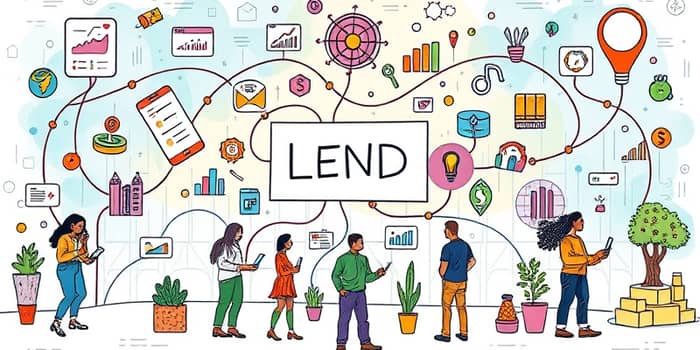
As the financial landscape undergoes a profound transformation, digital lending has emerged at the forefront of innovation. From AI-driven underwriting to contextual credit embedded within everyday platforms, lenders are creating new digital products with data-driven insights that empower consumers and businesses alike.
Across the globe, players are harnessing technology to deliver seamless, instant, and personalized financing solutions—reshaping credit markets and redefining access to capital.
Macro Context & Market Size
By 2024, the global digital lending market valued USD 8.89 billion, and forecasts anticipate growth to USD 37.56 billion by 2034 at a 15.5% CAGR. Meanwhile, digital lending platforms—providing software and infrastructure—are set to expand from USD 19.27 billion in 2025 to USD 45.06 billion by 2029 at 23.7% CAGR.
In 2025, global fintech-originated lending soared to approximately USD 590 billion, representing 63% of U.S. personal loan originations and over half of SME loans in developed markets. Outstanding fintech loan balances surpassed USD 500 billion by mid-2025, underscoring the sector’s mainstream reach.
Key drivers behind this expansion include:
- Smartphone and internet penetration fueling digital access
- Consumer demand for instant, on-demand credit experiences
- Growth of e-commerce, the gig economy, and regulatory inclusion initiatives
- Advances in AI, machine learning, cloud infrastructure, and open APIs
- Economic volatility driving lenders to enhance risk management
Buy Now, Pay Later & Installment Financing
Buy Now, Pay Later (BNPL) has become a flagship product category, offering short-term installment loans at checkout with transparent fees and instant decisions. Loan terms span six weeks to 36 months, configured through flexible origination engines.
- Instant approvals embedded in checkout
- No or low interest, transparent fees
- Merchant benefits: higher conversion and larger baskets
Regulatory scrutiny is increasing around consumer protection and over-indebtedness, while competition with credit cards intensifies. Merchants subsidize 0% APR promotions via discount rates and partnership agreements.
Point-of-Sale (POS) Lending
POS lending delivers financing at the moment of purchase, either online or in-store. Underwriting occurs in seconds through a blend of credit history and transaction-level merchant data—including ticket size and return rates.
Omnichannel integration leverages in-store terminals, QR codes, and e-commerce APIs to power both short-term BNPL and longer-term closed-end installment loans.
Embedded Lending & Embedded Finance
Embedded lending embeds credit directly into non-financial platforms—e-commerce sites, SaaS tools, ride-hailing apps, and B2B marketplaces—via APIs. Customers access contextual credit at the point of need without leaving their primary workflow.
- New revenue streams without building regulated infrastructure
- Distribution at scale and lower acquisition costs
Use cases range from merchant working-capital offers within dashboards to inventory financing in procurement software and gig-worker income advances in delivery apps.
Peer-to-Peer Marketplaces
P2P lending platforms connect individual investors with borrowers through modular, API-first loan management systems. These marketplaces support fractionalized loans, auto-invest strategies, and secondary-market trading of loan assets.
Specialized P2P offerings, such as green loans, student financing, and SME credit, harness community capital to serve niche segments more effectively than traditional channels.
Revenue-Based & Merchant Cash-Flow Lending
Merchant Cash Advances (MCAs) and revenue-based finance provide capital repaid as a percentage of daily or weekly sales rather than fixed installments. Platforms pull real-time sales data from POS systems and payment processors, enabling AI-powered risk alerts and dynamic underwriting.
E-commerce merchants, restaurants, retail stores, and SaaS businesses leverage these solutions to align financing with volatile revenue streams and preserve cash flow.
Green & Sustainability-Linked Lending Products
As climate action gains prominence, lenders are rolling out green home-improvement loans, electric vehicle financing, and sustainability-linked corporate credit tied to ESG KPIs. These products feature preferential rates for environmentally beneficial projects and terms aligned with reduced utility costs.
This strategic pivot bolsters global climate goals, attracts ESG-focused investors, and creates diversified retail and SME product lines.
Specialized Small-Business & SME Products
Fintech platforms now originate over half of SME loans in developed markets, offering embedded invoice financing, dynamic discounting, and working-capital lines linked to card sales or subscription revenue.
Risk models rely heavily on cash-flow and transaction data, supplemented by sector-specific scorecards for restaurants, e-commerce, logistics, and more.
Consumer Lending Innovations Beyond BNPL
Digital channels power personal loans, auto financing with instant pre-approvals, and debt refinancing journeys. Increasingly, lenders leverage segmentation and personalization via AI-driven pricing to tailor terms, limits, and hardship tools within servicing portals.
Decentralized & Blockchain-Based Lending
DeFi platforms introduce smart-contract loans secured by on-chain collateral and automated liquidations. Tokenized assets and blockchain collateral registers hint at future integrations with bank-grade credit products.
Traditional banks are experimenting with tokenized currencies and digital assets to remain competitive and explore novel secured lending models.
Technology Under the Hood
AI, machine learning, and alternative data are a core differentiator across the loan lifecycle. Lenders use thousands of data points—from employment history to behavioral signals—to build holistic borrower profiles.
Applications include automated income verification, real-time fraud detection, dynamic pricing engines, and predictive collections strategies, driving efficiency and risk mitigation.
Risks, Challenges, & Regulatory Considerations
Rapid innovation brings data privacy concerns, cybersecurity threats, and model governance challenges. Regulators worldwide are tightening consumer protection and capital requirements, forcing fintechs to adopt a comprehensive approach to risk management.
Ensuring ethical AI use, preventing over-indebtedness, and maintaining fair lending practices remain critical to sustaining growth and trust.
The Road Ahead: Future Outlook
As lending evolves, collaboration between banks, fintechs, regulators, and technology providers will define the next decade. By embracing collaborative innovation for sustainable financial inclusion, the industry can deliver equitable access, resilient risk frameworks, and products that support both economic growth and environmental stewardship.
Stakeholders should invest in open APIs, robust data infrastructure, and transparent governance to unlock the full potential of digital lending and shape a more inclusive financial future.
References
- https://lendfoundry.com/blog/top-lending-models-in-2025-how-lendfoundry-helps-you-stay-ahead/
- https://www.businesswire.com/news/home/20251106677922/en/Digital-Lending-Growth-Analysis-and-Outlook-Report-2025-2034-Future-$37.56-Bn-Market-Intensifies-as-Fintechs-Banks-and-Alt-Lenders-Compete-on-Speed-AI-Innovation-and-Customer-Experience---ResearchAndMarkets.com
- https://www.finwise.bank/news/fintech/2025-lending-trends-automation-embedded-finance-economic-shifts/
- https://www.researchandmarkets.com/reports/5766975/digital-lending-platform-market-report
- https://hesfintech.com/blog/lending-trends-2025/
- https://fintech-market.com/blog/business-lending-trends-2025
- https://www.finastra.com/viewpoints/articles/comprehensive-2025-lending-outlook
- https://www.amraandelma.com/lending-platform-marketing-statistics/
- https://www.accenture.com/us-en/insights/banking/top-10-trends-banking-2025
- https://defisolutions.com/answers/digital-lending-trends-to-watch-in-2024/
- https://stripe.com/resources/more/digital-lending-101-how-its-changing-the-banking-and-loan-servicing-industry
- https://www.firstbank.com/resources/learning-center/top-banking-trends-to-watch-in-2025/
- https://www.thebusinessresearchcompany.com/report/digitization-in-lending-global-market-report
- https://www.velera.com/insights/blog/2025-trends-innovation-predictions-for-the-new-year-and-beyond
- https://www.leadsquared.com/industries/lending/consumer-lending-trends/
- https://www.worldbank.org/en/about/unit/brief/transforming-finance-to-meet-today-s-development-needs