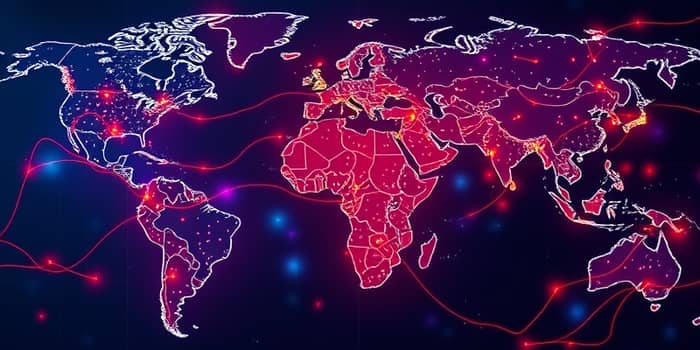
As 2026 unfolds, the global economy stands at a crossroads. After the tumultuous years of the pandemic and geopolitical upheavals, growth is projected at roughly 2.4 to 3.3 percent, a pace that is steady but fragile compared to pre-2020 benchmarks. In this era of rapid technological progress and shifting policy landscapes, businesses and individuals must learn to navigate uncertainty with foresight and agility.
In this article, we explore the drivers propelling growth, the risks that threaten stability, and actionable strategies to build resilience. By understanding the contours of financial flux, you can position yourself to seize opportunities amidst change.
Understanding the Changing Landscape
Multiple authoritative sources, including the IMF, ACCA, UNCTAD, and Oxford Economics, forecast global GDP growth between 2.4 percent and 3.3 percent in 2026. While the IMF sees a modest uptick to 3.3 percent, other analysts expect growth to hover just above 3 percent or slide closer to 2.4 percent. This variance highlights both the resilience and fragility of current dynamics.
Regionally, the picture diverges sharply. The United States is poised to remain the fastest-growing major economy, benefiting from ongoing AI investment and fiscal stimulus, with forecasts above 1.5 percent growth. China’s expansion cools to around 4.6 percent as structural challenges persist. Europe languishes near 1 percent, constrained by political debates over fiscal policy and a possible second shock from China. India emerges as a bright spot, driven by robust domestic demand and infrastructure pushes, while developing economies ex-China are expected to grow near 4.2 percent.
Driving Forces Behind Growth
Several powerful currents are propelling the world economy forward. Understanding these forces can help you align decisions and investments with emerging trends.
- AI-Driven Productivity Gains: Investment in artificial intelligence is accelerating productivity across industries. From automated manufacturing to data-driven services, the AI boom acts as a shock absorber, offsetting headwinds elsewhere.
- Monetary and Fiscal Easing: With inflation moderating globally, central banks in the US, China, Japan, and Europe have room to maintain lower rates. Governments continue targeted fiscal stimulus, especially in areas like green infrastructure and digital transformation.
- Trade Resilience and Diversification: Despite tensions, global trade surpassed $35 trillion in 2025. Regional value chains are reinforcing economic ties in Asia, while South-South trade deepens, particularly in Africa and Latin America.
- Private Sector Adaptability: Firms are leveraging technology and lean operations to navigate policy shifts. Agile business models and digital platforms enhance resilience in the face of rapid economic changes.
Risks on the Horizon
Even as engines of growth hum, potential shocks loom large. Preparing for downside scenarios is essential to safeguarding financial health.
- Escalating Geopolitical Tensions: Renewed tariffs, supply chain fragmentation, and political stand-offs—particularly between the US, China, Iran, and the EU—could derail trade flows and investment.
- AI Bubble or Backlash: Enthusiasm for AI may outpace actual productivity gains, triggering a market correction reminiscent of past technology bubbles.
- Fiscal and Debt Strains: Public debt remains elevated across advanced economies. Rising bond yields could strain budgets, pushing policymakers toward austerity and slowing growth.
- Regional Overcapacity and Insolvencies: Manufacturing overcapacity in China, combined with rising insolvencies in parts of Europe and emerging markets, poses systemic risks.
Strategies for Businesses and Individuals
Thriving amid financial flux requires proactive measures. Whether you’re steering a multinational or managing personal finances, these strategies can bolster your position:
- Build diversified portfolios: Spread assets across sectors and geographies to cushion against localized shocks.
- Invest in digital skills: Upskill in AI, data science, and cybersecurity to remain competitive in a technology-driven marketplace.
- Maintain liquidity buffers: Keep adequate cash reserves to weather market volatility without resorting to forced asset sales.
- Adopt agile planning: Embrace scenario analysis and flexible budgets to pivot quickly when conditions change.
Regional Outlook at a Glance
Looking Ahead: Three Trends to Watch
According to ACCA analysts, three pivotal trends will shape the next phase of global growth:
- AI Developments and Productivity Proof—Will AI deliver real gains or spark a market correction?
- Bond Market Dynamics—Rising yields from fiscal strains could tighten financial conditions unexpectedly.
- Evolution of Global Trade—New tariff regimes and regional alliances will redefine supply chains.
Expert Insights and Policy Imperatives
Renowned economists warn that markets may have underpriced uncertainty. Professor Kenneth Rogoff cautions that public debt crisis probabilities exceed 50 percent over the next five years, signaling higher borrowing costs and tighter budgets. Meanwhile, the IMF urges governments to restore fiscal buffers, pursue structural reforms, and reduce policy unpredictability.
Business leaders emphasize resilience through decarbonization, digital adoption, and regional partnerships. Ebrima Sawaneh notes that African economies can leverage digital innovation and green transitions to offset external headwinds. In the US and Europe, industry associations advocate for balanced policy frameworks that foster innovation without stifling growth.
Conclusion: Navigating the Flux
As the world economy settles into its new normal, growth remains possible—but never guaranteed. By understanding the interplay of technological advances, policy shifts, and geopolitical currents, you can craft strategies that not only defend against risks but also harness emerging opportunities.
Embrace adaptability, invest in future-proof skills, and cultivate financial buffers. In a time defined by rapid economic shifts, those who anticipate change and act decisively will steer a course toward sustainable success.
References
- https://www.accaglobal.com/gb/en/professional-insights/global-economics/global-economic-outlook-2026.html
- https://unctad.org/news/10-trends-shaping-global-trade-2026
- https://www.oxfordeconomics.com/key-themes-2026/
- https://www.imf.org/en/publications/weo/issues/2026/01/19/world-economic-outlook-update-january-2026
- https://www.coface.com/news-economy-and-insights/economic-outlook-for-2026-preparing-european-businesses-for-turbulence
- https://www.spglobal.com/market-intelligence/en/news-insights/research/2026/01/global-economic-outlook-january-2026
- https://www.weforum.org/meetings/world-economic-forum-annual-meeting-2026/sessions/global-economic-outlook-af4fed3639/
- https://policy.desa.un.org/themes/macroeconomic-analysis/world-economic-situation-and-prospects-2026