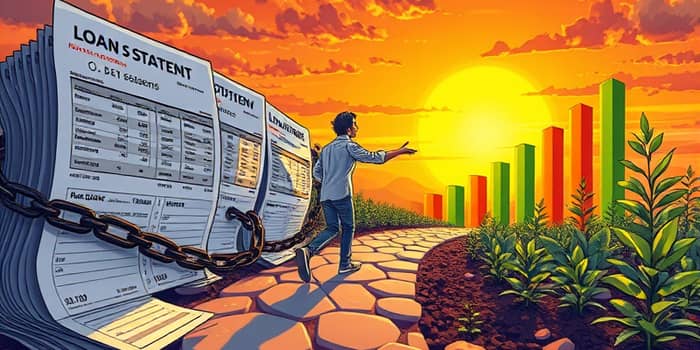
Debt shapes economies and households alike, often obscuring pathways to growth and security. By examining global trends and personal strategies, we can chart a course toward lasting prosperity.
Understanding the Global Debt Landscape
At the system level, total global debt—public and private—reached an astounding USD 251 trillion in 2024, equivalent to just above 235% of world GDP. After peaking at 258% during the COVID crisis, this ratio stabilized yet remains above pre-pandemic levels. Nearly 93% of GDP corresponds to public obligations, while private liabilities—households and non-financial corporates—account for under 143%.
Advanced economies saw a slight reduction in total debt, from 270% to 267% of GDP, driven largely by a fall in private borrowing. Meanwhile, public liabilities edged up to around 110% of GDP. Emerging markets and developing economies, by contrast, recorded increases in both public debt—rising two percentage points to 69% of GDP—and private borrowing, which climbed to 122% of GDP, about eight points above its pre-pandemic baseline.
Key drivers of this environment include persistent fiscal deficits around 5% of global GDP, fueled by legacy COVID costs and rising net interest payments. On the private side, tighter credit conditions and elevated rates curbed household borrowing in some regions, while corporate sectors in others—particularly in parts of Asia and Latin America—leveraged low-cost financing to fund expansion and acquisitions.
The Toll on LMICs
Low- and middle-income countries (LMICs) face a particularly harsh debt environment. From 2022 to 2024, they experienced net external debt outflows of USD 741 billion—the largest in half a century—while their external debt stock crept up just 1.1%, to USD 8.9 trillion. Rising interest payments on that stock have more than doubled over the last decade, leaving many governments trapped in a growing cycle of debt traps.
- Debt service crowds out spending on health, education, and social protection.
- Capital flight deepens fiscal strain and weakens growth prospects.
- Lack of transparency and coordination hampers effective debt management.
Experts warn that even with restructuring or grace periods, many LMICs remain on a treadmill of servicing old debts at the expense of future development, driving wider inequality and stalling poverty reduction efforts.
Government Debt: Prosperity vs. Vulnerability
Debt sustainability hinges not only on ratios, but on interest rates, growth prospects, and institutional strength. Wealthy nations with deep capital markets, like Japan and the United States, manage to service high debts at low funding costs. By contrast, lower-income countries with moderate debt loads often face steep borrowing rates and limited fiscal space.
These contrasts underscore how institutional frameworks and market confidence shape the true burden of public liabilities.
Personal Debt: The Household Reality
Behind the macro figures, millions of households grapple with credit card balances at 15–25%+ APR, student and auto loans, mortgages, medical bills, and a surge in buy-now-pay-later services. Stagnant incomes, rising living costs, and easy access to credit can push families into cycles of dependence on high-cost borrowing just to meet basic needs.
High interest rates magnify outstanding balances, while minimum payments often cover only interest, leaving principal untouched. Economic shocks—job loss or medical emergencies—can force reliance on payday loans or credit increases, compounding vulnerability.
Pathways Out of Debt: Individual Strategies
Foundational Steps to Regain Control
The first stage in rebuilding financial health is to stop incurring new debt. That may mean putting away credit cards, avoiding new accounts, or even freezing your credit profile to prevent unwanted inquiries and identity theft. At the same time, focus on creating a realistic budget that tracks every dollar in and out, identifying non-essential spending to cut.
- Build an emergency fund to weather unexpected shocks.
- Involve family members for shared accountability and goals.
- Review recurring subscriptions and negotiate lower rates where possible.
Strategic Repayment Methods
Once new borrowing stops, the next step is to prioritize repayments efficiently. The debt avalanche method directs extra funds toward the highest-rate balance first, minimizing total interest outlays. Alternatively, the debt snowball method tackles the smallest balances first, fostering early wins to maintain momentum. Both approaches rely on discipline and incremental increases—just a USD 20–50 monthly boost can shave months off your payoff timeline.
Regularly automate payments, track progress visually, and celebrate milestones to reinforce positive behavior. By staying committed, you turn incremental sacrifices into long-term gains.
Building Lasting Prosperity
True financial freedom extends beyond eliminating current debts. It requires cultivating savings habits, investing in human capital, and aligning spending with core values. Establishing an ongoing emergency fund, contributing to retirement accounts, and exploring low-cost investment vehicles ensures you’re not just debt-free but also building wealth.
Ultimately, the journey from burdened borrower to financially empowered individual or nation is guided by knowledge, discipline, and resilience. By applying macro insights and micro tools in concert, we can dismantle the obstacles of debt and pave new pathways to shared prosperity.
References
- https://www.imf.org/en/blogs/articles/2025/09/17/global-debt-remains-above-235-of-world-gdp
- https://communityresourcefcu.com/effective-debt-reduction-strategies-for-financial-freedom/
- https://www.westernsouthern.com/personal-finance/debt-reduction-strategies
- https://blogs.worldbank.org/en/opendata/international-debt-report-2025--when-relief-isn-t-enough---lmics
- https://valexfcu.org/mastering-debt-management-strategies-stay-top
- https://www.visualcapitalist.com/state-of-world-debt-in-2025/
- https://www.cbsnews.com/news/most-effective-debt-relief-strategies-to-use-now-experts-say/
- https://www.worldbank.org/en/programs/debt-statistics/idr/products
- https://www.navyfederal.org/makingcents/credit-debt/debt-repayment-strategies.html
- https://www.oecd.org/en/publications/2025/03/global-debt-report-2025_bab6b51e.html
- https://emarquettebank.com/financial-education/articles-insights-for-you/debt-reduction-strategies
- https://unctad.org/publication/world-of-debt
- https://dfpi.ca.gov/news/insights/three-steps-to-managing-and-getting-out-of-debt/
- https://en.wikipedia.org/wiki/List_of_countries_by_government_debt
- https://extension.wvu.edu/youth-family/finances/blog/2025/04/01/smart-strategies-for-effective-debt-management