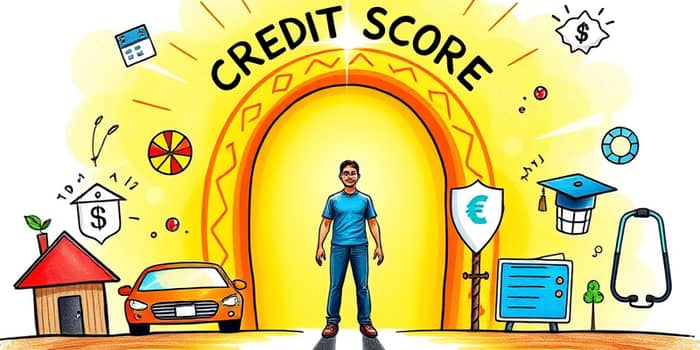
Your credit score is often viewed simply as a three-digit measure for loan approvals. But this number carries the power to influence nearly every facet of your life—from the interest you pay to the opportunities you pursue. In this article, we explore the hidden depths of credit, revealing how you can harness its full potential to build a secure, prosperous future.
Understanding Credit Scores
At its core, a credit score is a statistical risk assessment tool guiding decisions by lenders. Most scores range from 300 to 850 and predict the likelihood of on-time repayment. The two dominant models—FICO and VantageScore—analyze your credit report, drawing data from payment history, balances, account age, credit mix, and recent inquiries.
While FICO has reigned supreme since 1989, used by over 90% of lenders, VantageScore emerged in 2006 to introduce new nuances, such as including rental history. Industry-specific scores further tailor calculations for mortgages, auto loans, and credit cards, fine-tuning risk assessment with metrics like down payments and income ratios.
The Mechanisms Behind the Numbers
Every credit model weights its factors slightly differently, but FICO’s framework remains the most instructive. By understanding these weights, you can focus your efforts on the areas that matter most:
Notice how minimize interest costs over your lifetime relies heavily on maintaining a long history of responsible borrowing and keeping utilization below 30%. Late payments linger for seven years, making punctuality your single most impactful habit.
Extending Influence: Beyond Borrowing
A strong credit profile unlocks much more than financing—it grants access to better rates, higher approvals, lower deposits across services:
- Home mortgages: Qualify for lower interest mortgages that save tens of thousands over decades.
- Auto loans: Secure favorable loan terms that reduce monthly payments.
- Rentals and utilities: Avoid hefty security deposits and meet landlord criteria.
- Insurance premiums: Lower auto and homeowner rates tied to credit-based scores.
Employers and landlords increasingly view credit as a snapshot of your financial reputation. Your score can influence job eligibility, apartment leases, even cell phone contracts. In healthcare, studies show hospitalizations and serious illnesses often trigger score drops equivalent to unemployment effects.
Harnessing Credit for Life Goals
When you appreciate credit as a lifelong tool rather than a loan gateway, it becomes a means to achieve aspirations. Consider using a high score to finance advanced education, expand a small business, or invest in energy-efficient home upgrades. Each use carries the opportunity to grow your wealth and improve quality of life.
By planning strategically, you can leverage promotional rates and balance transfers to consolidate high-interest debt. Additionally, tapping into home equity at competitive rates can fund major expenses like weddings or medical bills without resorting to payday loans or credit cards.
Building and Protecting Your Score
Improvement starts with consistency. Focus on fundamental actions that drive the greatest gains:
- Pay all bills on time; set auto-pay where possible to avoid missed deadlines.
- Maintain credit utilization below 30% on each revolving account.
- Diversify your accounts: mortgages, installment loans, and credit cards.
- Limit new credit inquiries; space out applications over time.
Conversely, avoid practices that erode trust in your profile: delinquent payments, maxing out cards, and opening multiple new accounts in quick succession. Regularly review your credit reports for errors or fraudulent activity, and dispute inaccuracies promptly.
Embracing Credit’s True Potential
Your credit score is not merely a barrier to borrowing—it is a versatile instrument that, when wielded responsibly, empowers you to unlock opportunities and secure a stable future. Understanding its mechanics and broad impacts allows you to shape your financial destiny.
By treating credit as an ongoing project rather than a one-time transaction, you harness its full power. Cultivate strong habits, adapt to new scoring models, and seek professional guidance when complex decisions arise. In doing so, you step beyond the narrow confines of the three-digit number and into a world where credit truly unleashes its potential.
References
- https://www.debt.org/credit/report/scoring-models/
- https://www.sccu.com/articles/personal-finance/how-credit-score-can-impact-purchasing-power
- https://consumer.ftc.gov/credit-scores
- https://drbank.com/whats-new/your-credit-score-and-its-impact-on-your-personal-financial-goals/
- https://www.equifax.com/personal/education/credit/score/articles/-/learn/how-is-credit-score-calculated/
- https://pmc.ncbi.nlm.nih.gov/articles/PMC6187788/
- https://bettermoneyhabits.bankofamerica.com/en/credit/how-credit-score-is-calculated
- https://www.equifax.com/personal/education/credit/score/articles/-/learn/how-do-your-actions-affect-your-credit-scores/
- https://www.wellsfargo.com/goals-credit/smarter-credit/credit-101/why-so-many-credit-scores/
- https://nul.org/blog/your-credit-why-credit-reports-and-scores-matter-your-financial-health
- https://www.experian.com/blogs/ask-experian/credit-education/score-basics/understanding-credit-scores/
- https://financialaid.berkeley.edu/center-for-financial-wellness/financial-literacy-hub/understanding-credit/
- https://www.fhfa.gov/policy/credit-scores
- https://www.chase.com/personal/credit-cards/education/build-credit/financial-decisions-that-lead-to-poor-credit
- https://www.discover.com/credit-cards/card-smarts/how-is-credit-score-calculated/