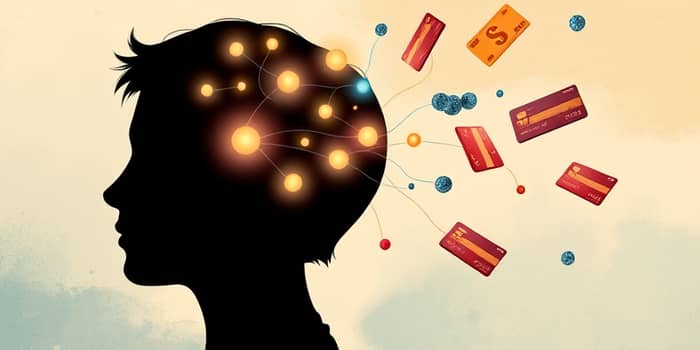
When we think about credit, numbers and spreadsheets often dominate our minds.
Yet, beneath the surface, powerful psychological forces are at play, shaping every financial choice we make.
Understanding these hidden mental drivers can unlock a path to better credit health and financial freedom.
This journey into the mind reveals that credit is not just about income or debt ratios.
It is deeply intertwined with our personalities, emotions, and cognitive processes.
By tapping into this knowledge, you can gain control over your financial destiny.
Let's delve into the fascinating world where psychology meets finance.
The Psychology Behind Credit Decisions
Our credit behavior is influenced by a complex web of psychological traits.
Research shows that factors like effective financial decision-making and self-control are key predictors.
These traits often outperform traditional metrics in forecasting credit risk.
For instance, conscientious individuals tend to have better credit histories.
They exhibit strong self-discipline and plan ahead for health and pensions.
This makes them more reliable borrowers in the eyes of lenders.
By recognizing these traits in yourself, you can start to build healthier habits.
Here are some psychological factors that significantly impact credit behavior:
- Effective financial decision-making: Enhances ability to manage loans wisely.
- Self-control: Helps resist impulsive spending and ensures timely payments.
- Conscientiousness: Linked to achievement orientation and better savings.
- Selflessness or a giving attitude: Can reduce risk by fostering responsibility.
- Attitude toward money: Influences willingness to access and manage debt.
In contrast, neuroticism has shown insignificant impact on repayment, though it affects economic variables.
This highlights the nuanced role of personality in financial contexts.
Theoretical Frameworks and Mental Perspectives
Credit use can be understood through various psychological lenses.
These include situational factors, personal traits, cognitive processes, and social influences.
They operate across three phases: pre-acquisition, acquisition, and post-acquisition.
Behavioral economics introduces the concept of System 1 and System 2 thinking.
System 1 is automatic and intuitive, often leading to emotional purchases.
System 2 is deliberate and rational, but under stress, heuristics can derail decisions.
Interactionist psychology emphasizes that behavior stems from both personality and external factors.
This framework helps explain why people with similar incomes may have different credit outcomes.
Consider how these perspectives play out in real life:
- Situational factors: Economic conditions or peer pressure that spur borrowing.
- Personal traits: Innate tendencies like risk aversion or optimism.
- Cognitive processes: Mental shortcuts that affect loan choices.
- Social processes: Family or cultural norms around debt and spending.
By mapping these perspectives, you can identify areas for personal growth.
Psychological Ownership of Borrowed Money
A fascinating concept is psychological ownership of borrowed funds.
Consumers often feel a sense of possession over money they borrow.
This increases their willingness to use credit, especially credit cards over loans.
Studies show that psychological ownership positively predicts credit card borrowing.
It adds significant predictive power beyond traditional controls like debt aversion.
This feeling is linked to efficacy and positive self-identity.
For example, in experiments, higher ownership correlated with more credit searches.
Understanding this can help you manage borrowing urges more effectively.
Here are key insights from research on psychological ownership:
- It boosts credit card usage by making borrowed money feel more personal.
- It outperforms metrics like discount rates in forecasting behavior.
- It is tied to real-world actions, such as applying for new credit.
- Recognizing this bias can lead to more mindful financial decisions.
By acknowledging this tendency, you can set boundaries to avoid overborrowing.
Credit and Mental Health: A Two-Way Street
The link between credit and mental health is bidirectional and profound.
Low area credit scores are associated with higher anxiety and depression symptoms.
ZIP codes with poorer credit averages show elevated reports of mental distress.
Creditworthiness impacts financial well-being, often inducing anxiety.
Changes in credit market conditions can affect mental health via regulatory shifts.
This creates a cycle where financial stress worsens psychological states.
Breaking this cycle requires addressing both credit habits and emotional health.
Here are ways credit and mental health interact:
- Poor credit can lead to stress, which impairs decision-making.
- Mental health issues may reduce ability to manage debts effectively.
- Improving credit can alleviate anxiety and boost overall well-being.
- Seeking support for mental health can enhance financial resilience.
By fostering a healthy mindset, you can improve both your credit and life quality.
Neuroscientific and Behavioral Drivers of Spending
Our brains play a crucial role in credit-related behaviors.
Credit cards activate reward centers in the brain, encouraging more spending.
This neural sensitization can lead to impulsive purchases and debt accumulation.
Cognitive biases, such as overconfidence, heavily influence credit decisions.
Psychological manipulations in experiments have effects equivalent to interest rate changes.
This shows how mental shortcuts shape financial outcomes.
By becoming aware of these drivers, you can counteract their negative effects.
Key neuroscientific insights include:
- Credit cards trigger dopamine release, making spending feel rewarding.
- Stress can shift thinking from deliberate to automatic, increasing risk.
- Biases like anchoring affect how we perceive loan terms and costs.
- Mindfulness practices can help regulate brain responses to financial stimuli.
Implementing strategies like delayed gratification can mitigate these impulses.
Historical Applications and Practical Insights
Psychology has been applied in credit decisions for decades.
Harvard's Entrepreneurial Finance Lab pioneered psychometric borrower profiling in 2006.
This approach assesses personality traits, intellectual ability, and fairness.
In Mongolia, studies validated questionnaires linking traits to repayment behavior.
Positive traits like decision-making were linked to higher incomes and credit experience.
This demonstrates real-world utility of psychological assessments.
You can leverage these insights to enhance your own credit profile.
Here are practical steps based on historical applications:
- Assess your psychological traits through self-reflection or tools.
- Focus on building self-control and conscientious habits.
- Use frameworks like the credit phases to plan borrowing wisely.
- Incorporate behavioral economics tips to avoid common pitfalls.
By adopting these practices, you can align your mindset with financial success.
Research Gaps and Future Directions
While much is known, gaps remain in understanding credit psychology.
Studies often focus on pre-acquisition traits, neglecting social perspectives.
Geographical imbalances exist, with more research in Western contexts.
Future work needs to explore inter-perspective links and global implications.
This highlights the evolving nature of financial psychology.
As research advances, new tools and insights will emerge to help consumers.
Staying informed can empower you to adapt to changing knowledge.
Key areas for future exploration include:
- How social networks influence credit acquisition and use.
- The role of culture in shaping attitudes toward debt.
- Long-term effects of psychological interventions on credit scores.
- Integration of technology with psychometric profiling for personal finance.
By anticipating these trends, you can proactively manage your credit journey.
This table summarizes how key traits influence credit and offers actionable steps.
By focusing on these areas, you can cultivate a psychology that supports financial health.
Remember, your mind is a powerful tool in mastering credit.
Embrace this knowledge to create a brighter, more secure future.
References
- https://pmc.ncbi.nlm.nih.gov/articles/PMC8067141/
- https://onlinelibrary.wiley.com/doi/10.1080/00207594.2011.628674
- https://publichealth.jhu.edu/2025/low-area-credit-scores-linked-to-higher-anxiety-and-depression
- https://mitsloan.mit.edu/experts/how-credit-cards-activate-reward-center-our-brains-and-drive-spending
- https://www.nber.org/papers/w11892
- https://pubsonline.informs.org/doi/10.1287/mnsc.2023.00194